
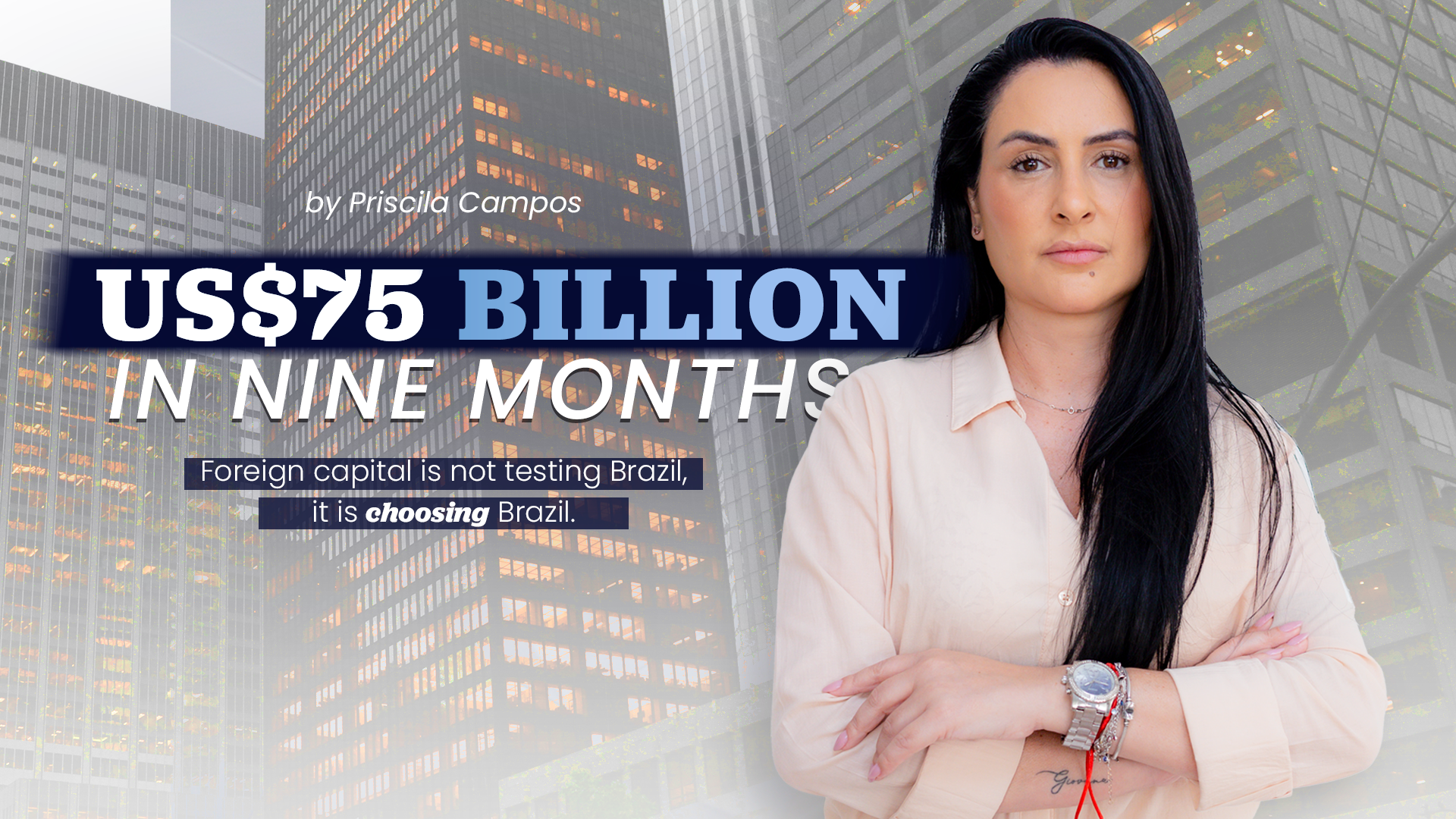
Foreign direct investment had already exceeded the Central Bank’s forecast for the whole of 2026 by September. The figure reveals a great deal about how international capital views the country.
Priscila Campos, CEO of Grupo International
Key points
- Brazil received US$11.3 billion in direct investment in September, the highest amount for that month since the historical series began in 1995.
- The 2026 year-to-date total reached US$75.7 billion, exceeding the Central Bank’s forecast for the entire year.
- In 2025, the country was the world’s third-largest destination for direct investment according to the OECD, behind only the United States and China, and fifth according to UNCTAD.
- While short-term capital was leaving the country, productive capital reached record levels.
September 2026 will be remembered as a milestone in Brazil’s external accounts. The country received US$11.3 billion in foreign direct investment, the highest amount for the month since the Central Bank began its historical series in 1995. The median market forecast was US$6.5 billion, and not even the most optimistic estimate reached the actual result.
The most revealing figure, however, is the cumulative total. Between January and September, inflows totaled US$75.7 billion, above the US$75 billion that the Central Bank itself had projected for the full twelve months of the year. With an entire quarter still to be accounted for, the annual forecast had already been exceeded.
Direct investment should not be confused with financial investment. It is capital that builds industrial plants, acquires significant stakes in companies, and expands operations. It is the most reliable indicator of long-term confidence because it reflects decisions made with a decades-long horizon.
A Chosen Destination in a Selective World
This performance becomes more significant when viewed in a global context. In 2025, worldwide foreign direct investment grew by only 6%, according to UNCTAD, and more than 80% of flows were concentrated in twenty economies. International capital became more selective, more concentrated, and more demanding.
In this environment, Brazil increased its inflows from US$63 billion to US$77 billion and consolidated its position among the world’s leading destinations. UNCTAD ranked the country fifth. The OECD placed it third, behind only the United States and China, a position held by few economies worldwide.
“Foreign capital is not testing Brazil. It is choosing Brazil.”
The Most Significant Signal in the Data
One aspect of the September figures deserves special attention. In the same month that direct investment set a record, foreign portfolio investments in stocks, funds, and bonds recorded net outflows of US$2.1 billion.
The divergence is telling. Short-term capital reacts to current conditions: interest rates, exchange rates, and news. Productive capital responds to fundamentals. The fact that one retreats while the other advances indicates that confidence in the country is anchored in fundamentals rather than speculative cycles.
The composition of inflows reinforces this interpretation. Of September’s US$11.3 billion, US$3.8 billion consisted of reinvested earnings. Foreign companies already established in Brazil are generating profits here and choosing to keep those earnings in the country. Few indicators express confidence so concretely.
| Indicator | Value |
| Direct investment in September 2026 | US$11.3 billion |
| January–September 2026 cumulative total | US$75.7 billion |
| 12-month cumulative total | US$88.3 billion (3.43% of GDP) |
| Reinvested earnings in September | US$3.8 billion |
Source: Central Bank of Brazil
The Drivers of Investment
Three areas account for much of foreign capital’s interest. The first is renewable energy, which has become the main driver of investment attraction. In a world under pressure to decarbonize, Brazil’s clean energy mix has ceased to be merely an environmental asset and has become a competitive advantage for energy-intensive industries.
The second is greenfield projects, ventures built from the ground up, particularly electric vehicles and wind and solar power generation. This form of investment has the greatest economic impact because it creates new productive capacity rather than merely transferring ownership of existing assets.
The third is digital infrastructure: networks, fiber optics, and data centers designed for artificial intelligence.
These choices are not random. Brazil brings together attributes that rarely coexist in a single market: consumer scale, clean energy, strategic resources, and a tradition of geopolitical neutrality that is increasingly valued in a fragmented international environment.
The Window Is Open, but Not Indefinitely
It would be a mistake to interpret the record as a guarantee of the future. Investment cycles do not sustain themselves through inertia; they depend on allocation decisions continually renewed in the world’s major financial centers.
UNCTAD itself points to a paradox worth noting: in Latin America, the volume of capital is growing, but the number of new projects is declining. Resources are arriving faster than the capacity to turn them into ventures. And the obstacles are well known: bureaucracy that extends timelines and legal uncertainty that makes every decision more costly.
Working with international investors teaches a lesson worth recording. High interest rates are accepted because they can be priced in. Regulatory unpredictability is not, because it cannot. Stable rules are worth more than any temporary incentive.
The Role of Brazilian Companies
Every billion dollars entering the country requires people on the ground to turn it into operations: local partners, qualified suppliers, service providers, co-investors, and professionals prepared to work to international standards.
That is where the opportunity lies for Brazilian businesses. Foreign capital does not replace Brazilian companies; it expands the reach of those structured to become part of its value chain. Organizations that prepare now will grow at the pace of this cycle. Those that wait for greater clarity in the outlook are likely to find a market already occupied.
The 2026 record shows that international capital trusts Brazil’s fundamentals. Whether that confidence turns into a lasting cycle will depend on two conditions: stable rules and companies prepared to participate in the value chains this investment is creating.
In your view, which conditions are decisive for turning this record into a lasting cycle of growth? I invite you to share your perspective in the comments.
Priscila Campos is a businesswoman and CEO of Grupo International, working in international business and the establishment of foreign companies in Brazil.